Androgenic Alopecia: Why Men and Women Lose Hair Differently
This blog post is about androgenic alopecia (male and female pattern baldness) - the most common type of hair loss that affects both men and women.
4 min read

Androgenic alopecia, commonly known as male or female pattern baldness, is the most common cause of hair loss worldwide. Despite affecting both sexes, it manifests quite differently in men and women, with distinct patterns, causes, and progression rates. Understanding these differences is crucial for recognizing the early signs and choosing the right treatment approach.
If you've noticed your hairline receding, your part getting wider, or more hair in your brush than usual, you might be dealing with androgenic alopecia. Let's break down what this condition really means and how it affects men and women differently.
What Is Androgenic Alopecia?
Androgenic alopecia is a genetically determined form of hair loss that's driven by sensitivity to dihydrotestosterone (DHT), a hormone derived from testosterone. The name itself tells the story: "androgenic" refers to male hormones (androgens), while "alopecia" simply means hair loss.
This isn't the type of hair loss that happens overnight due to stress or illness. Instead, it's a gradual process that typically begins in your twenties or thirties and progresses slowly over years or decades. The key difference from other types of hair loss is that androgenic alopecia follows predictable patterns and is permanent without treatment.
Androgenic Alopecia in Men
How It Develops
Male pattern baldness typically starts early and follows a well-documented progression. Most men begin noticing changes in their late teens to early thirties, though it can start even earlier for those with strong genetic predisposition.
The process begins when hair follicles become sensitive to DHT. This hormone binds to receptors in the follicles, causing them to shrink gradually. As follicles miniaturize, they produce progressively thinner, shorter, and lighter-colored hairs before eventually stopping hair production altogether.
The Classic Pattern
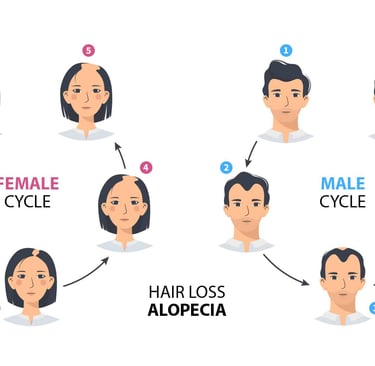
Men's hair loss follows the Hamilton-Norwood scale, which maps seven stages of progression:
Early stages typically involve a receding hairline at the temples, creating the characteristic "M" shape. You might notice your forehead looks higher or that styling your hair forward doesn't hide the recession like it used to.
Middle stages see the crown (vertex) beginning to thin, often creating a circular bald spot at the back of the head. Many men don't notice this initially since it's hard to see without mirrors.
Advanced stages involve the hairline and crown areas expanding and eventually meeting, leaving hair only on the sides and back of the head in a horseshoe pattern.
Symptoms in Men
The signs of male pattern baldness are usually straightforward:
Hairline recession: The hairline gradually moves backward from the temples
Crown thinning: Hair becomes sparse at the top-back of the head
Changing hair texture: New growth becomes finer and more fragile
Increased shedding: More hairs on pillows, in the shower, or when styling
Visible scalp: Scalp becomes increasingly visible through thinning hair
Causes Specific to Men
While genetics play the primary role, several factors influence male pattern baldness:
Genetic inheritance: Contrary to popular belief, the baldness gene doesn't come only from your mother's side. You can inherit hair loss susceptibility from either parent, and having bald relatives on both sides increases your risk significantly.
DHT sensitivity: Men naturally produce more testosterone, which converts to DHT. The more sensitive your follicles are to this hormone, the earlier and more aggressively you'll lose hair.
Age: Testosterone levels and DHT production change with age, often accelerating hair loss in your thirties and forties.
Lifestyle factors: While not direct causes, stress, poor diet, smoking, and certain medications can accelerate genetically predetermined hair loss.
Androgenic Alopecia in Women
How It Develops Differently
Female pattern hair loss is more complex and often more emotionally devastating than male pattern baldness. Women typically experience diffuse thinning rather than complete baldness, and the progression is usually slower and less predictable.
The same DHT sensitivity drives female pattern hair loss, but women's lower testosterone levels and higher estrogen levels create different manifestations. Additionally, hormonal fluctuations throughout a woman's life significantly impact how and when hair loss occurs.
The Female Pattern
Women's hair loss follows the Ludwig scale, which describes three main stages of diffuse thinning:
Stage 1: Slight thinning along the center part, often dismissed as normal aging or styling damage Stage 2: Noticeable widening of the part with visible scalp showing through Stage 3: Significant thinning across the top of the head, though complete baldness is rare
Unlike men, women rarely experience complete hair loss in any area. Instead, hair becomes progressively thinner and shorter across the entire top of the head, while the hairline typically remains intact.
Symptoms in Women
Female pattern hair loss symptoms can be subtler initially:
Widening part: The center part gradually becomes more visible and wider
Overall thinning: Hair feels less dense and looks thinner all over
Reduced ponytail thickness: Hair ties need to be wrapped more times
Visible scalp: Scalp becomes noticeable when hair is pulled back or styled
Changed hair texture: Hair becomes finer, more fragile, and harder to style
Slower growth: Hair doesn't seem to grow as long as it used to
Causes Specific to Women
Female pattern hair loss involves additional complexity due to hormonal fluctuations:
Hormonal changes: Pregnancy, childbirth, menopause, and PCOS can all trigger or accelerate hair loss. The drop in estrogen during menopause is particularly significant
Genetic predisposition: Like men, women inherit hair loss susceptibility, but the expression can be influenced by hormonal changes throughout life.
Iron deficiency: Women are more prone to iron deficiency due to menstruation, which can compound genetic hair loss.
Thyroid disorders: Hypothyroidism and hyperthyroidism are more common in women and can accelerate hair loss.
Stress and lifestyle: Chronic stress, restrictive dieting, and certain hairstyling practices can worsen genetically predetermined thinning.
Age of Onset and Progression
In Men
Male pattern baldness typically begins in the late teens to early twenties, with about 25% of men showing signs by age 25. By age 50, approximately 50% of men experience significant hair loss. The progression is usually steady and predictable.
In Women
Female pattern hair loss typically starts later, often becoming noticeable in the thirties or forties. However, it can begin earlier, especially in women with PCOS or strong family history. The progression is often more gradual and can be episodic, with periods of stability followed by increased shedding.
The Role of Hormones
DHT: The Primary Culprit
Dihydrotestosterone is created when the enzyme 5-alpha-reductase converts testosterone. In genetically susceptible individuals, DHT binds to androgen receptors in hair follicles, causing them to shrink and eventually stop producing hair.
Gender Differences in Hormone Impact
Men have higher baseline testosterone levels, leading to more DHT production. Women have protective estrogen that can counteract some of DHT's effects, which is why female hair loss often accelerates after menopause when estrogen levels drop.
Since this is the most common type of hair loss, I'll be covering it in several upcoming blog posts with more detailed information.