
Understanding Hair Growth: The Cycle and Biology Behind It
Understanding this cycle isn't just academic curiosity—it's the foundation for recognizing when something's wrong and knowing which treatments actually work. Whether you're dealing with hair loss or simply want to optimize your hair health, everything starts with grasping the science behind how hair grows.
5/7/20254 min read
When you notice hair in your brush or falling in the shower, it's natural to wonder: is this normal, or should I be concerned? To answer that question, you need to understand how hair actually grows. Far from being a simple process, hair growth is a fascinating biological cycle that's both more complex and more predictable than most people realize.
Understanding this cycle isn't just academic curiosity—it's the foundation for recognizing when something's wrong and knowing which treatments actually work. Whether you're dealing with hair loss or simply want to optimize your hair health, everything starts with grasping the science behind how hair grows.
The Anatomy of a Hair Follicle
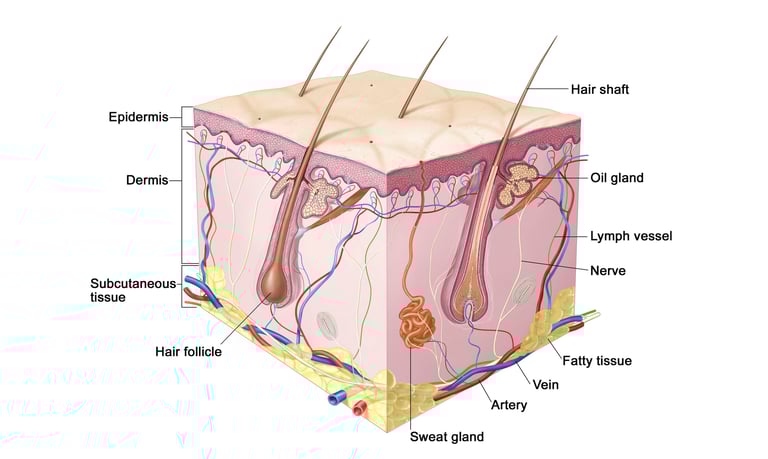
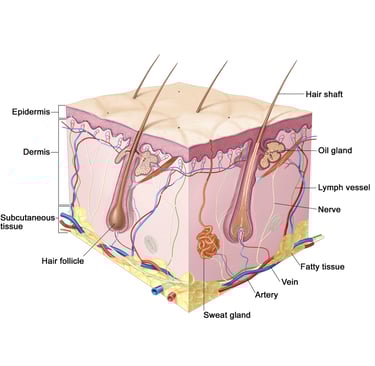
Before diving into the growth cycle, let's examine where it all happens: the hair follicle. Think of each follicle as a sophisticated biological factory, complete with its own blood supply, nerve endings, and stem cell reservoir.
The follicle extends deep into your scalp, reaching down to the subcutaneous fat layer. At its base sits the dermal papilla—a cluster of specialized cells that acts as the control center for hair production. These cells communicate with the hair matrix above them, where rapid cell division creates the hair shaft you eventually see.
Surrounding the follicle are sebaceous glands that produce oils to keep hair healthy, plus the arrector pili muscle that causes goosebumps and helps distribute these natural oils along the hair
shaft. This entire structure is what determines whether you'll have thick, healthy hair or struggle with thinning.
Anagen Phase: The Growth Factory
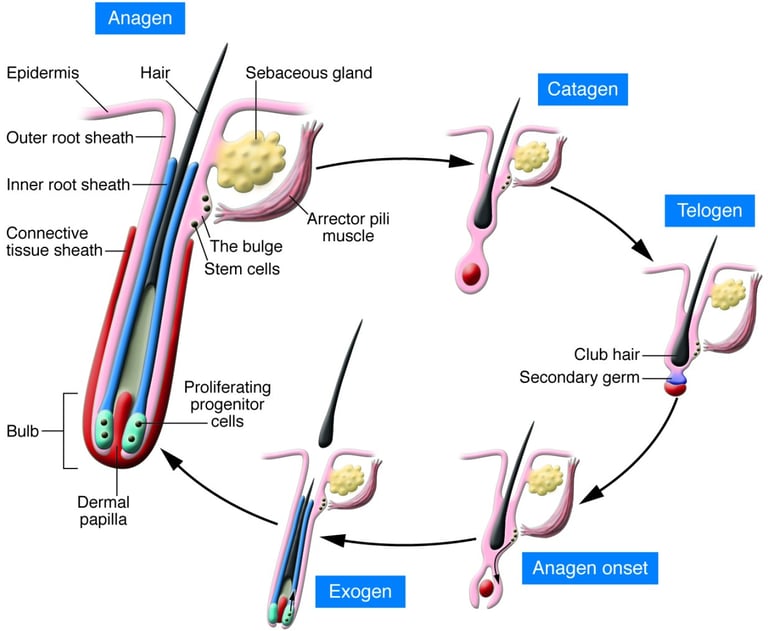
The anagen phase is where the magic happens. During this stage, cells in the hair matrix divide rapidly—some of the fastest-dividing cells in your entire body. This creates the hair shaft that pushes up through the follicle and emerges from your scalp.
For scalp hair, anagen typically lasts 2-7 years, though genetics largely determine the exact duration. This is why some people can grow their hair to their waist while others max out at shoulder length—it's all about how long their anagen phase lasts.
During peak anagen, hair grows approximately half an inch per month. The follicle is at its largest and most active, with a rich blood supply delivering nutrients to fuel rapid growth. About 85-90% of your hair is in this phase at any given time, which is why most of your hair appears to be growing simultaneously.
Catagen Phase: The Transition
The catagen phase is hair growth's transitional period, lasting just 2-3 weeks. During this time, cell division slows dramatically, and the hair follicle begins to shrink. The dermal papilla detaches from the hair matrix, cutting off the nutrient supply that fueled growth.
This phase affects only about 1-3% of your hair at any time. The hair shaft stops growing but remains anchored in the follicle. Think of it as the follicle taking a deep breath before the next phase.
Telogen Phase: The Rest Period
Telogen is the resting phase, lasting approximately 3 months for scalp hair. The hair follicle is completely inactive—no growth occurs, and the hair shaft sits loosely in the follicle, held in place only by the remaining root structure.
About 10-15% of your hair is in telogen at any given time. These are the hairs you lose during normal daily activities—brushing, washing, or even just running your fingers through your hair. This is why losing 50-100 hairs daily is completely normal and not a sign of balding.
Exogen Phase: The Shedding
Some researchers identify exogen as a separate fourth phase, though it overlaps with telogen. This is when the old hair actually sheds to make room for new growth. The follicle has already begun generating a new hair shaft in early anagen, which helps push out the old hair.
What Controls the Hair Growth Cycle?
The hair growth cycle isn't random—it's controlled by a complex interplay of hormones, genetics, and environmental factors.
Hormonal Influences
Hormones are the primary regulators of hair growth. Androgens like testosterone and its more potent derivative DHT (dihydrotestosterone) have the most significant impact. While these hormones promote hair growth in some areas (like facial hair in men), they can shorten the anagen phase and shrink follicles on the scalp, leading to androgenetic alopecia.
Estrogen generally supports hair growth by extending the anagen phase, which is why many women notice thicker hair during pregnancy and increased shedding after menopause or childbirth when estrogen levels drop.
Thyroid hormones also play a crucial role. Both hyperthyroidism and hypothyroidism can disrupt the hair cycle, leading to diffuse thinning or excessive shedding.
Genetic Programming
Your DNA contains the blueprint for your hair growth cycle. Genetics determine how long your anagen phase lasts, how sensitive your follicles are to hormones, and even the diameter and pigmentation of your hair shafts.
This genetic programming explains why hair loss patterns often run in families and why some treatments work better for certain individuals than others.
Age and the Changing Cycle
As you age, the hair growth cycle naturally changes. The anagen phase gradually shortens, meaning each hair doesn't grow as long before entering the resting phase. Follicles may also become smaller with each cycle, producing progressively finer hair—a process called follicular miniaturization.
The time between cycles may also increase, meaning it takes longer for new hair to replace shed hair. This is why hair often appears thinner and less dense with age, even without significant hair loss disorders.
The Four Phases of Hair Growth
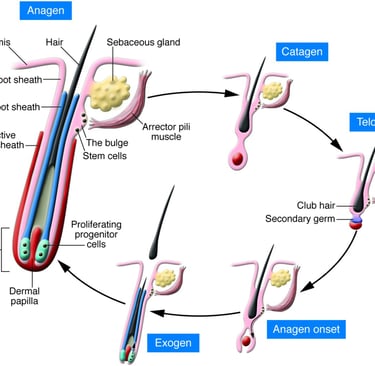
Hair growth follows a predictable cycle with four distinct phases. Understanding each phase explains why hair loss treatments take months to show results and why some shedding is completely normal.