Traction Alopecia: When Beauty Practices Cause Hair Loss
Traction alopecia is one of the most preventable forms of hair loss, yet it affects millions of people worldwide. Unlike genetic or autoimmune hair loss, traction alopecia is caused entirely by mechanical stress on hair follicles from tight hairstyles, hair accessories, or repetitive styling practices.
7 min read
What makes this condition particularly frustrating is that it's often the result of trying to look our best—tight ponytails for a sleek appearance, braids for protective styling, or extensions for added length and volume. The irony is that these beauty practices, meant to enhance our hair, can sometimes damage it permanently if we're not careful.
The good news? Understanding traction alopecia means you can prevent it, catch it early, and in many cases, reverse the damage before it becomes permanent.
What Is Traction Alopecia?
Traction alopecia is hair loss caused by sustained tension or pulling on hair follicles over time. The word "traction" literally means pulling or dragging force, which perfectly describes what happens to your hair with this condition.
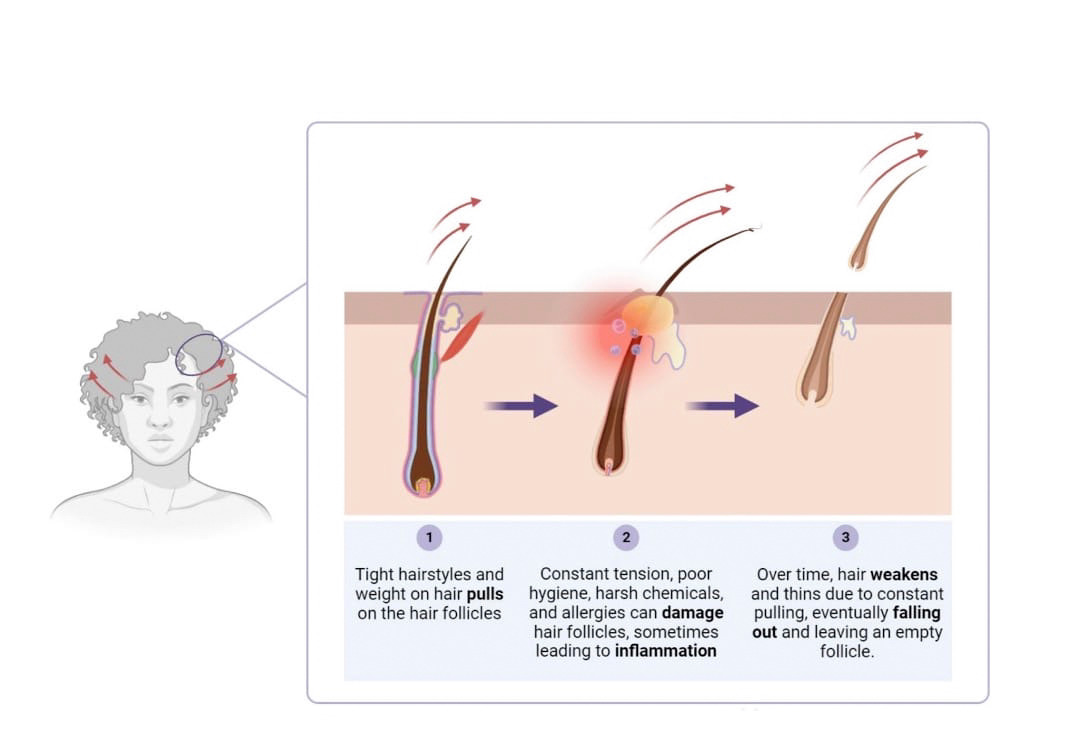
When hair is repeatedly pulled in the same direction or held under constant tension, it creates chronic stress on the hair follicles. Initially, this might just cause the hair shaft to break or the hair to shed prematurely. However, with continued tension over months or years, the constant pulling can actually damage the follicle itself, leading to inflammation, scarring, and eventually permanent hair loss.
Unlike androgenic alopecia or alopecia areata, traction alopecia is entirely mechanical—it's pure physics. Pull on something long enough and hard enough, and eventually, it will break or the foundation holding it will give way.
What Causes Traction Alopecia?
Tight Hairstyles
Ponytails and buns: Especially when pulled very tight or worn in the same position daily Braids: Tight cornrows, French braids, or any braiding that creates significant tension Updos: Elaborate styles that require tight pulling and lots of bobby pins or elastic bands Man buns and top knots: Particularly when the hair is pulled tightly back every day
Hair Extensions and Weaves
Clip-in extensions: When worn frequently or clipped too tightly Sewn-in weaves: Especially if the braids underneath are too tight Fusion extensions: Can create weight and tension on natural hair Tape-in extensions: When placed too close to the scalp or left in too long
Hair Accessories and Tools
Tight headbands: Especially elastic ones worn daily in the same position Hair ties: Particularly rubber bands or very tight elastic ties Bobby pins: When used excessively or in the same spots repeatedly Hair clips: Heavy clips or those that grip too tightly Helmets or hats: When worn tightly for extended periods (occupational hazard for some)
Cultural and Protective Styling Practices
Cornrows: Especially when braided too tightly Box braids: When the initial braiding creates too much tension Locs: Particularly during the initial "twisting" phase if done too tightly Bantu knots: When twisted too tightly or left in too long Protective styles: Ironically, styles meant to protect hair can sometimes cause traction alopecia if done incorrectly
Occupational Hazards
Athletes: Gymnasts, swimmers, and dancers who frequently wear tight ponytails Military personnel: Strict grooming standards requiring tight styles Healthcare workers: Tight ponytails or buns required for hygiene Food service: Hair pulled back tightly for safety and hygiene requirements
Trichotillomania (Hair-Pulling Disorder)
While technically different from traction alopecia, compulsive hair pulling can create similar patterns of hair loss through repetitive mechanical trauma.
Early Signs and Symptoms
The key to preventing permanent damage is recognizing traction alopecia in its early stages when it's still reversible.
Stage 1: Early Warning Signs
Scalp tenderness: Your scalp feels sore or sensitive, especially after taking down a tight style Broken hairs: You notice more short, broken hairs around your hairline or wherever tension is applied Bumps and irritation: Small bumps, redness, or irritation where hair accessories sit Difficulty styling: Hair seems more fragile or harder to manage in certain areas
Stage 2: Visible Thinning
Receding hairline: Most commonly affects the frontal hairline and temples Patchy thinning: Hair loss in specific areas where tension is repeatedly applied Widening part: The center part may become wider if you always part your hair in the same place Visible scalp: You can see more scalp through the hair in affected areas
Stage 3: Advanced Loss
Significant bald patches: Clear areas of hair loss that don't regrow between styles Scarring: The scalp may show signs of scarring or permanent damage Permanent changes: Hair doesn't grow back even when tension is removed
Who's at Risk?
Demographics
Women: More commonly affected due to frequent use of tight hairstyles Children: Particularly those whose hair is styled tightly for school or activities Athletes: Those who regularly wear tight ponytails or headgear Certain ethnic groups: Higher rates in communities where tight braiding or extensions are common cultural practices
Hair Types at Higher Risk
Curly or textured hair: May be more susceptible to breakage under tension Fine hair: Lacks the strength to withstand repeated pulling Previously damaged hair: Hair that's been chemically treated or heat-damaged is more vulnerable Hair with natural weak points: Some people have naturally more fragile hair follicles
Diagnosis
Physical Examination
Dermatologists can usually diagnose traction alopecia through visual examination:
Pattern recognition: The hair loss pattern typically matches areas of repeated tension Hairline assessment: Checking for recession or thinning at the frontal hairline Scalp examination: Looking for signs of inflammation, scarring, or follicle damage Hair pull test: Gently pulling on hairs in affected areas to assess fragility
Medical History
Styling practices: Detailed questions about your hair care routine and styling habits Timeline: When did you first notice hair loss, and what styles were you wearing? Family history: Ruling out genetic causes of hair loss Other symptoms: Any scalp pain, itching, or irritation
Dermoscopy
Using a specialized magnifying device, doctors can see:
Follicle inflammation
Signs of scarring
Hair shaft abnormalities
Areas where follicles have been damaged
Biopsy (Rare)
Only needed if the diagnosis is unclear or if there's concern about other conditions causing similar patterns of hair loss.
Treatment Options
The most important treatment for traction alopecia is removing the source of tension. Everything else is secondary to this fundamental step.
Immediate Interventions
Stop the damaging practices: This is non-negotiable. Continuing tight styles while trying to treat the damage is like trying to heal a wound while repeatedly reopening it.
Gentle hair care: Switch to loose, low-manipulation styles Massage: Gentle scalp massage can improve circulation to affected areas Anti-inflammatory care: Reduce scalp inflammation that may be contributing to follicle damage
Medical Treatments
Topical corticosteroids: Can help reduce inflammation in the early stages Minoxidil: May help stimulate regrowth in areas where follicles are damaged but not destroyed Antibiotics: If there's secondary bacterial infection from chronic irritation Intralesional steroid injections: For areas with significant inflammation
Natural and Supportive Treatments
Essential oils: Rosemary, peppermint, or castor oil may help with circulation and growth Scalp massage: Improves blood flow to affected areas Nutritional support: Ensuring adequate protein, iron, and vitamins for hair growth Stress management: Reducing overall stress that might impair healing
Advanced Treatments
Platelet-rich plasma (PRP): May help stimulate follicles in early-stage damage Low-level laser therapy: Could potentially help with regrowth Microneedling: May improve absorption of topical treatments and stimulate growth factors
Hair Transplantation
In cases where traction alopecia has caused permanent hair loss, hair transplantation might be considered. However, this should only be done after:
At least 12 months without any tight styling
Confirmation that the hair loss has stabilized
Assurance that damaging practices won't be resumed
Prevention Strategies
Safe Styling Practices
The tension test: If your hairstyle causes any scalp discomfort or tension headaches, it's too tight Rotate styles: Don't wear the same tight style day after day Limit duration: Even protective styles shouldn't be left in for more than 6-8 weeks Use proper accessories: Choose silk or satin hair ties instead of rubber bands
Protective Measures
Nighttime protection: Use silk or satin pillowcases and bonnets to reduce friction Gentle handling: Be extra careful when hair is wet and more fragile Regular breaks: Give your hair breaks between protective styles Professional installation: Have extensions or weaves installed by experienced professionals who understand proper tension
Hair Care Routine Adjustments
Moisturizing: Keep hair and scalp well-moisturized to prevent brittleness Gentle cleansing: Use mild shampoos and don't scrub aggressively Detangling: Start from the ends and work up, never force through tangles Heat protection: If you must use heat, always use protection products
Recovery Timeline
Early Stage Traction Alopecia (Reversible)
0-3 months: Focus on removing tension and reducing inflammation 3-6 months: May start seeing some regrowth if follicles weren't permanently damaged 6-12 months: Continued improvement and thickening of regrown hair
Advanced Stage (Partially Reversible)
6-12 months: Some improvement in areas where follicles are still viable 12+ months: Maximum recovery potential usually reached by this point Long-term: Some areas may never fully recover if scarring occurred
Living with Traction Alopecia
Emotional Impact
Traction alopecia can be particularly emotionally challenging because:
It's often seen as "self-inflicted" (though this isn't fair—many people don't realize the risks)
It may conflict with cultural or professional expectations about appearance
The affected areas (usually the hairline) are highly visible
Practical Adjustments
Hairstyle adaptations: Learning new, gentler ways to achieve desired looks Camouflage techniques: Using makeup, styling products, or strategic cutting to minimize appearance of thinning Gradual transitions: Slowly changing styling habits rather than dramatic overnight changes
Community and Support
Connecting with others who understand the challenges can be invaluable:
Online communities focused on healthy hair practices
Support groups for people with hair loss
Working with stylists who understand the condition
Special Considerations
Children
Parents and caregivers should be especially careful:
Children's hair follicles may be more susceptible to damage
Kids can't always communicate discomfort effectively
Establishing healthy hair practices early prevents problems later
Cultural Sensitivity
It's important to address traction alopecia with cultural sensitivity:
Many traditional styles can be done safely with proper technique
The goal isn't to eliminate cultural practices but to make them safer
Working with stylists who understand both hair health and cultural significance
Athletes and Professionals
For those who must wear their hair back for safety or professional reasons:
Rotate the position of ponytails or buns
Use gentle accessories
Give hair breaks whenever possible
Consider shorter styles that require less tension to secure
The Future of Prevention
Education and Awareness
Increasing awareness about traction alopecia through:
Education in beauty schools about safe styling techniques
Public health campaigns in at-risk communities
Better information from hair care product manufacturers
Product Innovation
Development of:
Gentler hair accessories designed to minimize tension
Better protective styling products
Early warning systems (like apps that remind you to change styles)
Research
Ongoing research into:
Why some people are more susceptible than others
Better treatments for early-stage damage
Ways to strengthen hair follicles against mechanical stress
Prevention Is Key
The most important message about traction alopecia is that it's almost entirely preventable. Unlike genetic hair loss or autoimmune conditions, you have complete control over whether you develop this condition.
This doesn't mean you have to give up all your favorite hairstyles—it just means being mindful about how you wear them. Listen to your scalp, rotate your styles, and don't ignore early warning signs.
Your hair is meant to last a lifetime. With proper care and awareness, you can enjoy beautiful, versatile styling without sacrificing your hair's long-term health. The key is finding the balance between looking good today and preserving your hair for tomorrow.
Final Thoughts
Traction alopecia serves as a reminder that sometimes our beauty practices need to be balanced with hair health considerations. The good news is that with awareness and some adjustments to your routine, you can have both beautiful styles and healthy hair.
If you suspect you might be developing traction alopecia, don't wait—early intervention can make the difference between temporary thinning and permanent hair loss. Your future self will thank you for the changes you make today.
If you're experiencing hair loss that you think might be traction alopecia, consult with a dermatologist or trichologist for proper diagnosis and treatment recommendations. This information is educational and shouldn't replace professional medical advice.